Why Your Heart Rate Variability Reveals Hidden Stress Patterns
Your heart rate variability (HRV) measures the tiny time differences between each heartbeat. Higher HRV signals a strong vagus nerve and better stress resilience, while lower HRV often points to nervous system strain or chronic stress buildup1.
What Is Heart Rate Variability and Why Does It Matter?
Most people think a healthy heart beats like a metronome. But that's actually a sign of trouble.
A resilient heart has natural rhythm variation. One beat might come at 1.0 seconds, the next at 0.95 seconds, then 1.02 seconds. These tiny fluctuations create your HRV.
Your vagus nerve drives this variation. It releases acetylcholine at your heart's pacemaker cells, creating those healthy rhythm changes1. Think of it like a skilled conductor adjusting the tempo of an orchestra in real time.
Here's the thing: stress flattens this variation. When your nervous system stays stuck in fight-or-flight mode, your heart loses its natural flexibility. The beats become rigid and predictable.
How Does the Vagus Nerve Control Your HRV?
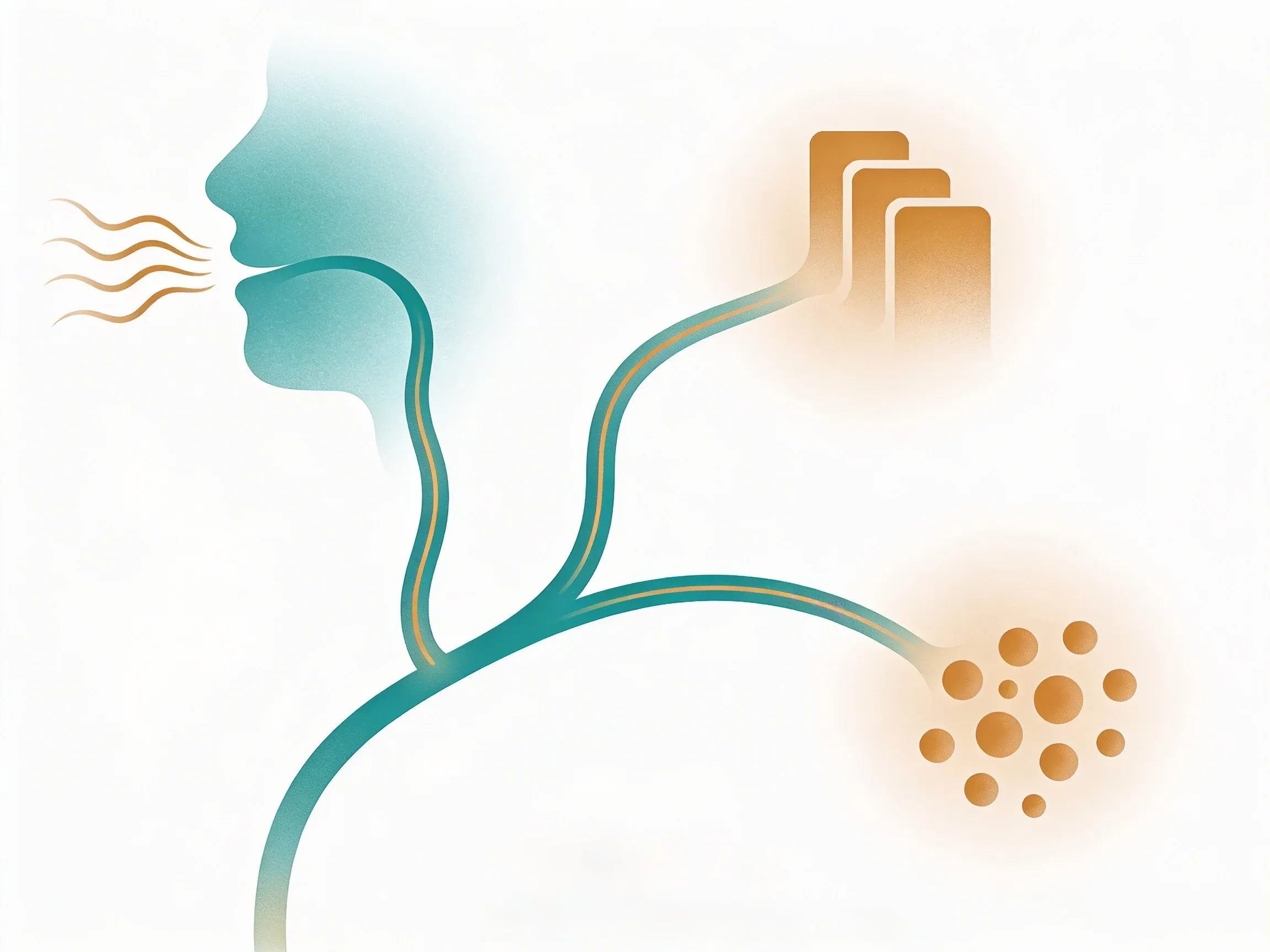
Your vagus nerve acts as the main brake pedal for your heart rate. It works through a direct connection to your heart's sinoatrial node -- the natural pacemaker.
When your vagus nerve fires, it releases acetylcholine. This chemical messenger tells your heart to slow down slightly. When vagal activity drops, your heart speeds up a bit. This constant push and pull creates the healthy variation in your HRV.
Under normal resting conditions, your vagus nerve dominates. This makes HRV primarily a measure of parasympathetic nervous system activity -- your body's rest-and-digest mode1.
The stronger your vagal tone, the more your heart rate can vary moment to moment. It's like having a car with responsive brakes versus one where the brake pedal barely works.
What Your HRV Numbers Actually Tell You About Stress
HRV serves as a real-time window into how well your nervous system handles daily pressures1. But the numbers need context.
A specific measurement called RMSSD reflects parasympathetic activity most directly. It correlates with lower allostatic load -- essentially, the cumulative wear and tear stress puts on your body1.
Higher HRV typically indicates:
- Better stress resilience
- Faster recovery after challenges
- Stronger emotional regulation
- More balanced nervous system function
Lower HRV often signals:
- Chronic stress or burnout
- Poor recovery between stressors
- Nervous system stuck in overdrive
- Reduced stress-handling capacity
But here's what most people miss: your personal baseline matters more than comparing to others. A slight drop from your normal range signals more than being below some universal "good" number.
To establish your personal baseline, measure HRV at the same time daily for 2-4 weeks -- ideally first thing in the morning while still in bed. Once you know your range, weekly check-ins help track meaningful changes without obsessing over daily fluctuations.
The Brain-Heart Connection Behind HRV
Your HRV reflects more than just heart function. It reveals the health of brain-heart communication pathways.
Higher brain regions connect to your vagus nerve through complex neural networks. When these connections work well, your brain can fine-tune heart rate based on what's happening around you1.
Stress disrupts this brain-heart coupling. Your higher brain centers -- the parts that help you stay calm and think clearly -- lose influence over your autonomic nervous system.
This explains why people with chronically low HRV often struggle with:
- Difficulty bouncing back from setbacks
- Feeling "wired but tired"
- Poor emotional regulation
- Physical tension that won't release
Improving HRV isn't just about heart health. It's about restoring that crucial brain-heart communication.
Can You Actually Improve Your HRV?
Research suggests that interventions targeting the vagus nerve can enhance parasympathetic activity, especially in people dealing with chronic stress2. However, the relationship between direct vagal stimulation and HRV changes may be more complex than many assume.
Some approaches that show promise include:
Breathing practices: Slow, rhythmic breathing at 6 breaths per minute for 10-20 minutes daily directly stimulates vagal pathways. The diaphragm connects to vagus nerve branches, making breath work a natural HRV enhancer. Consistent practice for 4-8 weeks typically shows measurable changes in HRV readings.
Stress management: Since chronic stress suppresses HRV, addressing the root causes -- sleep, relationships, work pressure -- often helps more than any single technique.
Vagus nerve stimulation: Some people explore vagus nerve stimulation devices as part of a broader wellness approach, though individual responses vary.
The key insight? HRV responds to overall nervous system health, not just isolated interventions. Think lifestyle patterns, not quick fixes.